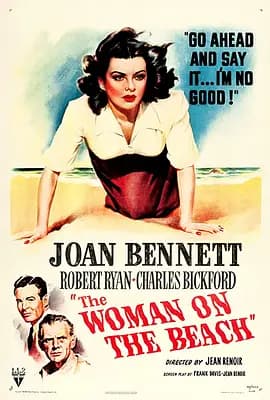
Woman on the Beach is a controversial film noir, an intense psychological drama about the world�s leading artist, recently blinded, who is obsessed with his condition and takes out his frustrations on his beautiful wife. A Coast Guard officer, recuperating from injuries suffered during the war, is drawn into their quiet conflict, and they become locked in an odd symbiotic relationship. This was the last American film by the French screen legend Jean Renoir. Critically panned when first released, the film later developed a cult following by many who consider it an existential masterpiece. A WWII Coast Guard veteran, Lt. Scott Burnett (Robert Ryan), is plagued by nightmares of his combat days. One day, he meets a woman, Peggy Butler (Joan Bennett), walking on a beach, picking up pieces of wood. Butler is married to a grumpy, blind painter, Ted Butler (Charles Bickford). Despite his affections for his fianc�e Eve (Nan Leslie), whose father is a boat builder, Scott falls in love with Peggy and soon breaks off the engagement. Peggy reveals that she blinded her husband years earlier by throwing a glass at him during an ugly spat, ruining his career and her own ambitions to be an upper-class socialite. Scott fears that Ted is suspicious that he is having an affair with Peggy and becomes so paranoid that he begins to believe that Ted is faking his blindness — and sets out to prove it. This was the fifth and final American film by the great French writer-director Jean Renoir.
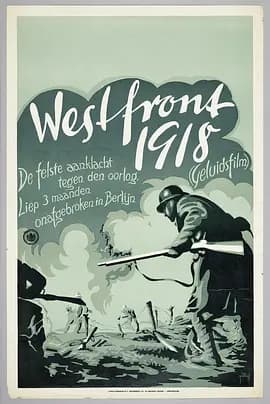
According to Sadoul in his "Dictionary Of Films": "The life and death of four average soldiers attached to the same company on the French front during the last months of World War I. Karl (Diessl), from Berlin, goes home on leave and finds his wife (Hoessrich) in bed with another man. A Bavarian (Kampers) takes life as it comes, while the lieutenant (Clausen) sticks to his duty. Anex-student (Moebis) falls in love with a French girl (Monnier) but loses her when the company moves on. All of them, sooner or later, meet a terrible end. Best sequences: the men buried alive during a bombardment; the first romantic meeting between the young student and Yvette; Berlin in the midst of food rationing with queues at all the shops; the death of the student at the hands of a wounded soldier in no-man's-land; the tank attack; the lieutenant going mad; the wounded and the dying in the ruined church converted into a field hospital. "Far better than the contemporary All Quiet On The Western Front, Westfront 1918 has little dialogue but gives tremendous dramatic force to natural sounds (Pabst refused to use music). As John C. Moore describes the final sequences: 'Pabst makes one last desperate effort to convey to us not only the horror of war but its futility and its gross stupidity as well.' Released to tremendous international acclaim, it still must be included among the finest war films ever made."
The story follows a nameless murderer, wearing a nightmarish mask, randomly murdering people across the U.S. in an attempt to secure his passage to hell. A patrolman’s pregnant wife, a fellow police officer, witnesses the killer murdering her husband and seeks to bring his to justice
Ethan Winter, an analytical detective, partners with driven DI Lauren Bell. His deductive genius aids her murder squad, but he's haunted by an unsolved murder of someone close to him.
Ethan Winter, an analytical detective, partners with driven DI Lauren Bell. His deductive genius aids her murder squad, but he's haunted by an unsolved murder of someone close to him.